City of Charleston Spring / Fishburne US 17 Drainage Improvements
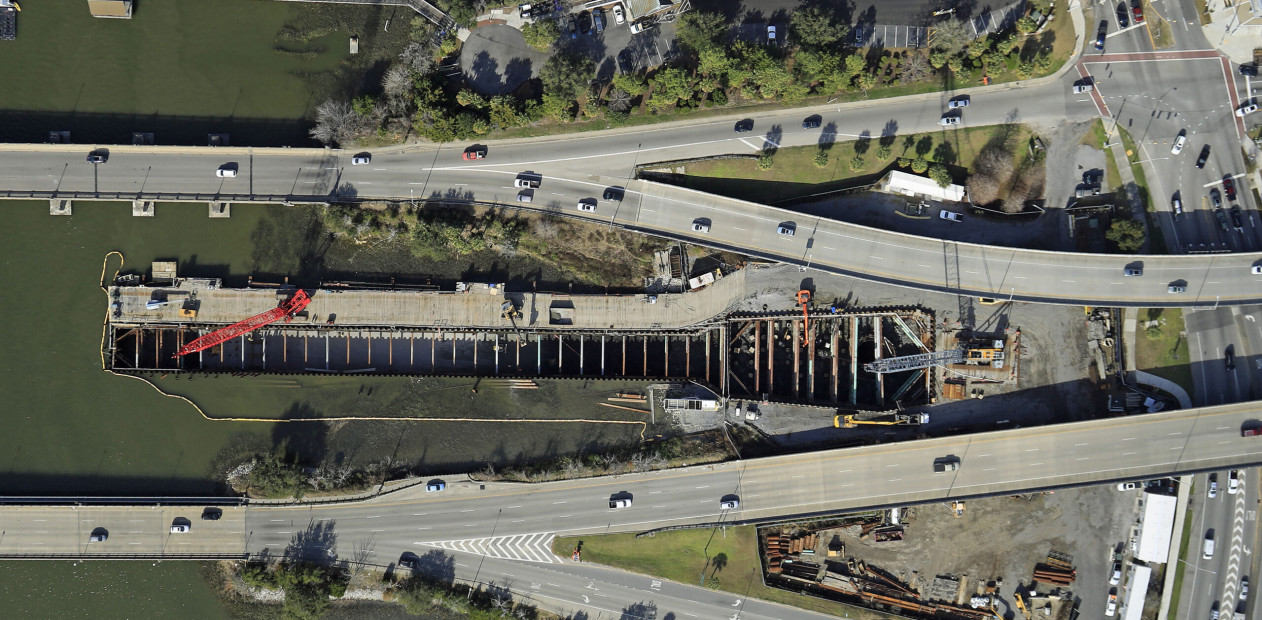
The Spring/Fishburne Project was a multi-phase effort to significantly improve drainage and reduce the frequency, duration, and severity of flooding caused by moderate to heavy rainstorms in the City of Charleston, South Carolina. Phase 4 of the Project required two major temporary cofferdams to be constructed for a 42-foot deep pump station and a 25-foot outfall. The cofferdam systems were laterally supported by up to three levels of cross-lot bracing, consisting of large-diameter steel pipe struts, keyed into the deep Cooper Marl formation, to provide effective water cut-off during excavation and construction. Challenges included constructing the cofferdams in a thick stratum of soft, highly compressible organic clay at the foot of the Ashley River.
MRCE performed soil-structure interaction finite element analyses to determine the design parameters and evaluate the potential impacts of excavation on the existing bridge piers. Based on iterative finite-element analysis, the stiffness of the cofferdams and lateral bracing systems was optimized to minimize settlement of adjacent transportation infrastructure. The Contract-specified instrumentation program was supplemented with additional monitoring mounted directly on the bridge piers to verify that movements of these important structures remained within allowable limits.
Interesting Facts
A key feature of the Phase 4 improvements is the high-capacity pump station system, designed to convey up to 360,000 gallons of stormwater per minute, providing critical flood relief to approximately 20% of the Charleston peninsula.